

A missed call is an unfinished request, not a confirmed job or a lost customer. A useful recovery workflow gives the caller a clear next step, captures only the context the team needs, and makes ownership visible when a person must take over. That is a more reliable operating goal than promising a booking, a revenue result, or a response time the team has not measured.
From missed call to a clear next action
Capture the job type, service area, urgency, and caller details. Separate emergency requests from routine requests and send each to the approved human or operational path. Route new jobs, existing customers, and billing questions to the configured destination. Record whether the request was answered, transferred, followed up, or left unresolved. The workflow should make the next owner and next action visible; it should not imply that a booking or revenue outcome occurred unless the connected system confirms it.
The first design decision is the outcome vocabulary. For example, a team might distinguish 'answered', 'transferred', 'follow_up_assigned', 'resolved', and 'unresolved'. The exact labels should match the operation. What matters is that a supervisor can tell the difference between a conversation that connected, a handoff that was accepted, and work that still needs attention.
Capture enough context for the next person
The intake should be short because the caller is trying to get help, not complete a long form. Start with the reason for calling. Then collect the service area, the broad job type, urgency, preferred callback details, and any other field that changes the route. If a detail does not change the next action, leave it out of the first pass.

A relevant existing editorial image for service-area and urgency intake. Illustration; not a product screenshot.
Use the configured destination as the source of truth for ownership. A new request may belong with dispatch, estimating, sales, or a general service queue. An existing customer may need a different team. A billing question should not enter the same path as a new job. The flow can ask the minimum routing question, show the resulting intent to the receiving team, and preserve the unanswered fields instead of filling them with guesses.
Separate emergency from routine requests
Emergency handling is a boundary, not a diagnosis feature. Define the language and situations that require an approved human or emergency-services path, then test that branch explicitly. The automated flow should not make a safety assessment it cannot support, give technical instructions outside the team’s policy, or keep a caller in an automated loop when immediate human attention is required.
Routine requests can follow a calmer path: capture what the caller needs, confirm the service area, collect a callback preference, and route the request to the configured destination. If the destination is unavailable, create the fallback outcome your team can actually own. A fallback that is only “try again later” is not a handoff; it is an unresolved exception.
Make the handoff and next action visible
A transfer is one event in the workflow. It is not proof that the receiving person accepted responsibility. Record whether the transfer was attempted, connected, accepted, or failed. If the caller agrees to a later contact, record the owner and the agreed condition or time. If the caller cannot be reached again, use a defined unresolved outcome rather than implying that the request was completed.
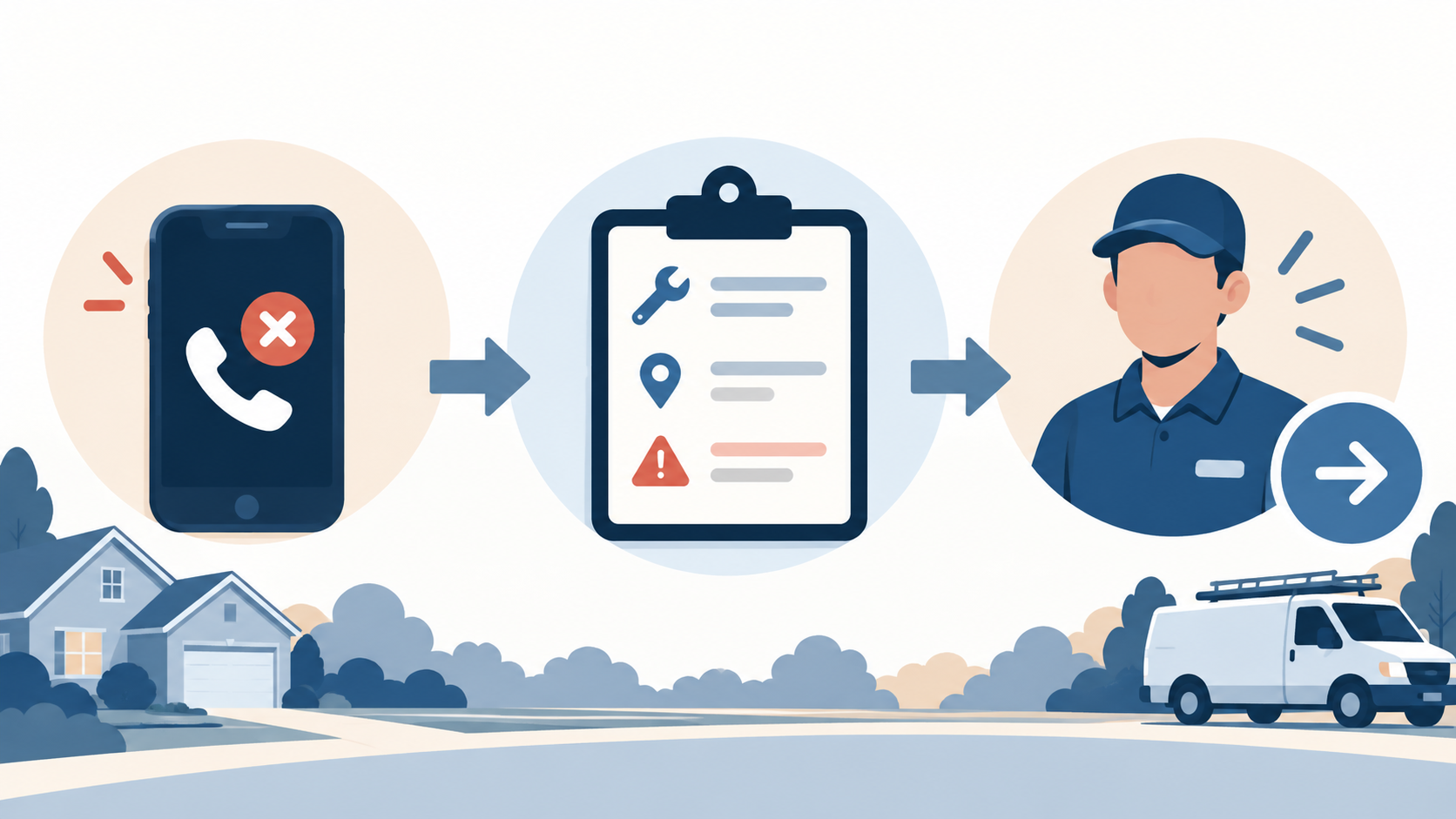
An operational map from missed call to captured request and accountable handoff. Illustration; not a product screenshot.
Keep the record useful to the next owner. A compact note can state the caller’s request, confirmed service area, urgency, route, action taken, and unresolved item. Structured fields should carry values that drive routing or follow-up. Do not turn a caller’s uncertainty into a confirmed diagnosis, price, appointment, or revenue result.
Review the workflow as an operating loop
Start with one route and review it with the people who receive the work. Walk through an unanswered call, a routine request, an emergency-boundary phrase, an existing-customer call, a billing call, a wrong-number call, and a failed transfer. For each case, ask whether the caller receives a clear next step, whether the receiving team has enough context, and whether the record shows who owns the remaining work.
CallTurbo’s home-services workflow page describes the broader route categories, while the AI call center guide explains how to test boundaries, providers, transfers, and outcomes. The solutions library is useful for comparing the first route with adjacent inbound, support, or missed-call workflows.
Measure recovery without inventing results
Track outcome coverage, notes completeness, follow-up completion, time to next action, and repeat-contact resolution by workflow and period. Keep call status, expressed intent, and action outcome separate. A connected call is not the same as a completed transfer, and an interested caller is not the same as a completed operational outcome.
Review unresolved outcomes with the team that owns them. Look for repeated missing fields, routes that are rarely accepted, requests that return because the next action was unclear, and emergency-boundary cases that need a stronger human path. These observations can guide a controlled change to the flow without claiming a business lift that has not been measured.
When the route, fields, permissions, and fallback owner are agreed, Start building with one workflow and a review cadence the team can maintain.
Frequently asked questions
Should every missed call start the same recovery path?
No. Use the caller’s consent, the configured channel, the reason for contact, and the team’s operating policy. A missed-call workflow should make the next step clear without assuming that every caller wants the same follow-up.
How should emergency requests be handled?
Define the emergency boundary with the responsible team and route those situations to the approved human or local emergency-services path. Do not use an automated conversation to diagnose a hazard or delay urgent care.
What should the team record after a recovery attempt?
Record the call status, confirmed intent, service area and urgency when relevant, route or transfer result, owner, next action, and unresolved exception. Store only the details needed for the next decision and the applicable operational record.
Does missed-call recovery guarantee a completed job?
No. It can make an intake and handoff more consistent, but it does not establish a booking, revenue result, or completed service outcome. Those claims require evidence from the connected system and the team’s own measurement.
Limitations
This guide is an operating framework, not legal, emergency, medical, pricing, or dispatch advice. Consent, recording, privacy, retention, calling-time, emergency handling, and data-access requirements depend on the operation and jurisdiction. Confirm the workflow, provider, fields, permissions, human destinations, and rollback plan before activating it.